Visual Culture视觉文化 · Guide指南
How to Build a Visual Reference With Intent
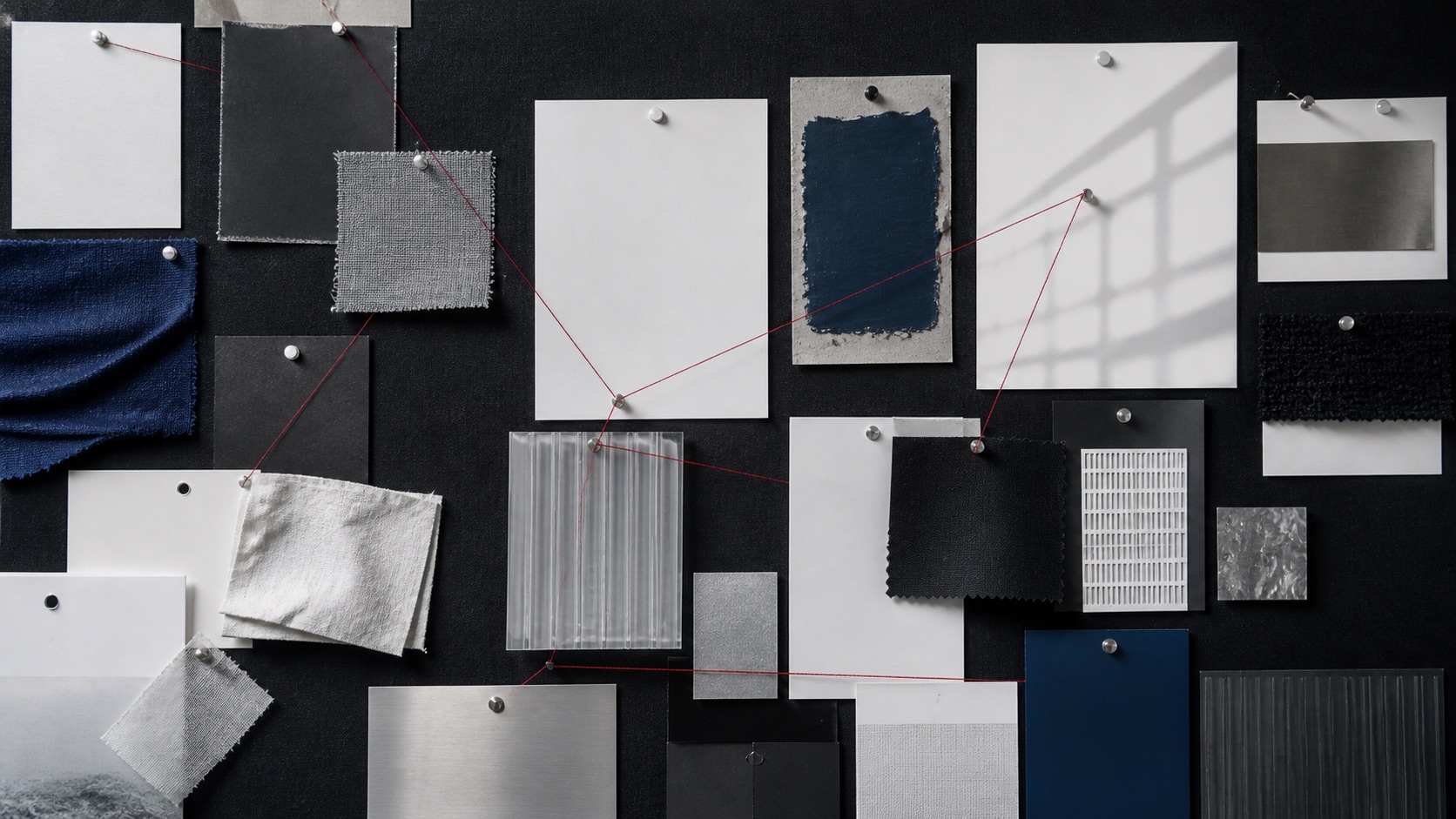
A reference board is most useful when it records visual questions and production decisions, not when it becomes a collage of admired surfaces.
Key takeaways核心要点
- Organize references by the decision they inform, such as scale, pace, or material.
- Write a short observation beside each image before inferring a reusable technique.
- Use references to define boundaries as well as possibilities.
A reference board can accelerate a conversation, but it can also conceal one. A collection of striking images may create agreement about taste while leaving the actual production choices unresolved. The useful version of a board is less like a mood collage and more like a working index: each item is attached to a question the team needs to answer.
Those questions might involve distance, light, texture, composition, type behavior, or the way an environment is introduced. They should be stated plainly enough that someone can disagree with the inference. “We need this feeling” is hard to test. “We need a wide opening that leaves one person visually exposed” is a decision a team can evaluate.
Collect by problem, not by prestige
Start with the story’s practical needs. Perhaps a project needs to show a crowded shared apartment without losing the lead character, or it needs a title sequence that feels direct but not loud. Make a small group for each problem rather than one undifferentiated board. A single image can appear in more than one group if it solves more than one question, but its role should be named each time.
For every item, write an observation before an interpretation. Observation might be: “The doorway occupies one third of the frame; the person is off-center; the back wall is low contrast.” Interpretation might be: “This arrangement leaves a visible route of exit.” Keeping these steps separate reduces the temptation to turn a personal response into a universal rule.
Translate the observation into an original constraint
The goal is not to reproduce an image or claim its identity as a style. Translate what you learned into a constraint appropriate to the new work. A reference may show how a simple foreground shape can divide two characters; the original constraint could become, “Use a nearby object to make their separation readable before dialogue.” The result may use a different setting, palette, medium, and composition.
This translation is where intention protects originality. It moves attention away from a recognizable surface and toward a visual function. If the team cannot explain the function without naming the source, the reference has not yet been digested. Keep working until the decision can stand on its own.
Include refusals on the board
An intentional board also says what not to borrow. A note might identify a lighting approach that is too polished for the story’s everyday setting, or a fast cut pattern that would obscure an important gesture. Negative examples clarify the limits of the direction. They are not failures of taste; they are evidence that the team has considered fit.
Review the board with production realities in view. Can the required contrast survive the available locations? Does the reference rely on a scale, resource, or process the project will not use? A constraint can still be useful when the exact image cannot be recreated. It may prompt a smaller, more appropriate alternative.
Let the board evolve with the work
Reference work should change after tests, rehearsals, or early layouts reveal something unexpected. A useful board records that change instead of pretending the first idea was complete. Remove images whose questions have been answered; add notes about what was learned from actual material.
The finished board is not a proof of visual sophistication. It is a trace of decisions: what the team observed, what it chose to carry forward, and what it intentionally left behind. That makes it more valuable than a collection of beautiful images, because it helps the resulting work become recognizably its own.