Production Workflow制作流程 · Analysis分析
Designing a Workflow Around Decisions
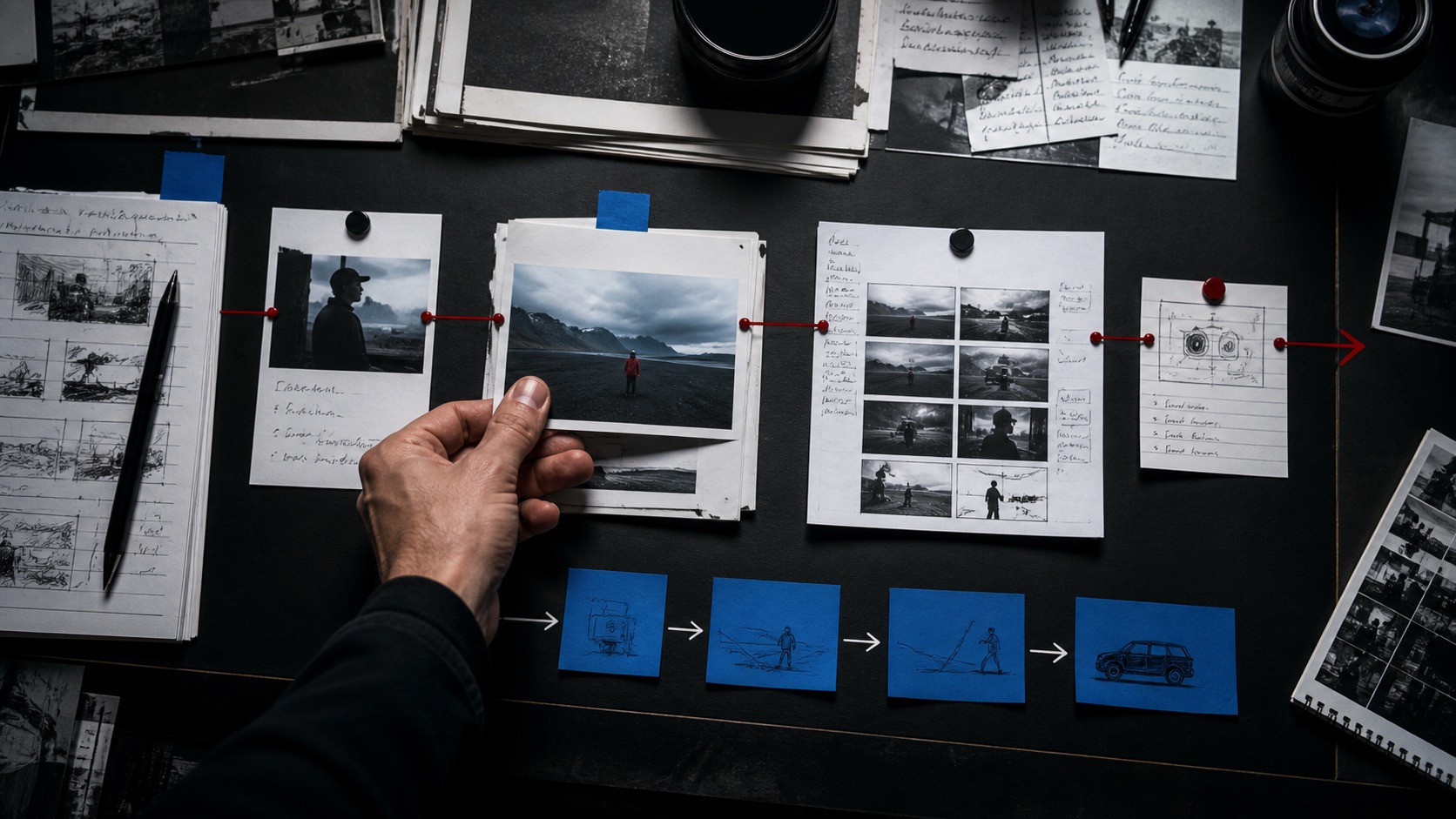
A production workflow should make important choices visible: who decides, what evidence they need, and how the outcome changes the next task.
Key takeaways核心要点
- Map work around irreversible or high-cost decisions, not a generic sequence of tools.
- Specify the decision owner, inputs, deadline, and resulting state.
- Use visible waiting states so blocked work is not mistaken for progress.
Many production boards show activity without showing choice. Tasks move from “to do” to “done,” yet the work may be waiting for someone to select an approach, confirm a constraint, or accept a trade-off. When those decisions are hidden inside chats and meetings, the board becomes a record of motion rather than a guide to progress.
A decision-centered workflow treats choice as part of the production model. It identifies the moments where uncertainty should be resolved, the people responsible for resolving it, and the work that can safely begin afterward. The method suits a small editorial project because it can be simple without being vague.
Find the decisions that shape downstream work
List the points where a late answer would create rework. Examples include selecting the story premise, choosing a cut branch, approving language treatment, confirming an output format, or deciding whether a technical issue is acceptable. Do not create a decision card for every preference. Focus on questions that alter ownership, scope, or a meaningful amount of later effort.
For each one, state the decision in plain language and name the viable options. “Choose opening A or B before sound work starts” is clearer than “review opening.” The wording should reveal what happens after a choice, including whether a rejected option is archived, revised, or tested again.
Imagine an unpublished mobile narrative with a choice between an immediate reveal and a delayed reveal. The decision record identifies the director as owner, the editor’s two cuts as inputs, and a review session as the evidence source. Until that choice closes, detailed audio work is intentionally waiting rather than appearing late or neglected.
Give the decision a usable lifecycle
Use a small set of states: proposed, gathering evidence, ready to decide, decided, implemented, and reopened. A decision that is merely discussed should not look decided. A decision that has been made but not yet reflected in the work needs a distinct state, otherwise people may assume the file already changed.
Set a decision deadline that matches its cost. An early premise choice may need deliberate discussion; an export-format choice may have a short operational deadline. If the owner cannot decide on time, record the escalation path or the default. A silent delay is a hidden scope change.
Capture the reason with the outcome. A sentence explaining which evidence mattered can prevent later contributors from undoing a deliberate choice. The record need not be a long meeting summary. It needs enough context to answer why the team chose this path when another path remained possible.
Build tasks from the chosen state
Once a decision closes, generate the next task from its result. An approved opening branch creates edit, sound, and review tasks tied to that branch; a delayed decision may create a bounded experiment instead. This prevents workers from advancing an assumption that no one has actually approved.
Review the board for tasks that lack a clear input state. If an editor is asked to “polish the cut” while the ending remains undecided, the workflow is asking for premature work. Reorder or narrow the task rather than expecting the individual to absorb the uncertainty alone.
Decision-centered planning does not remove creative ambiguity. It gives ambiguity a visible place, owner, and next test. That makes a workflow calmer: people can see what is open, what is settled, and why their task is ready now.