Production Workflow制作流程 · Explainer解读
What Belongs in a Shot List
A shot list should translate story intention into recordable coverage choices without pretending it can replace on-set judgment.
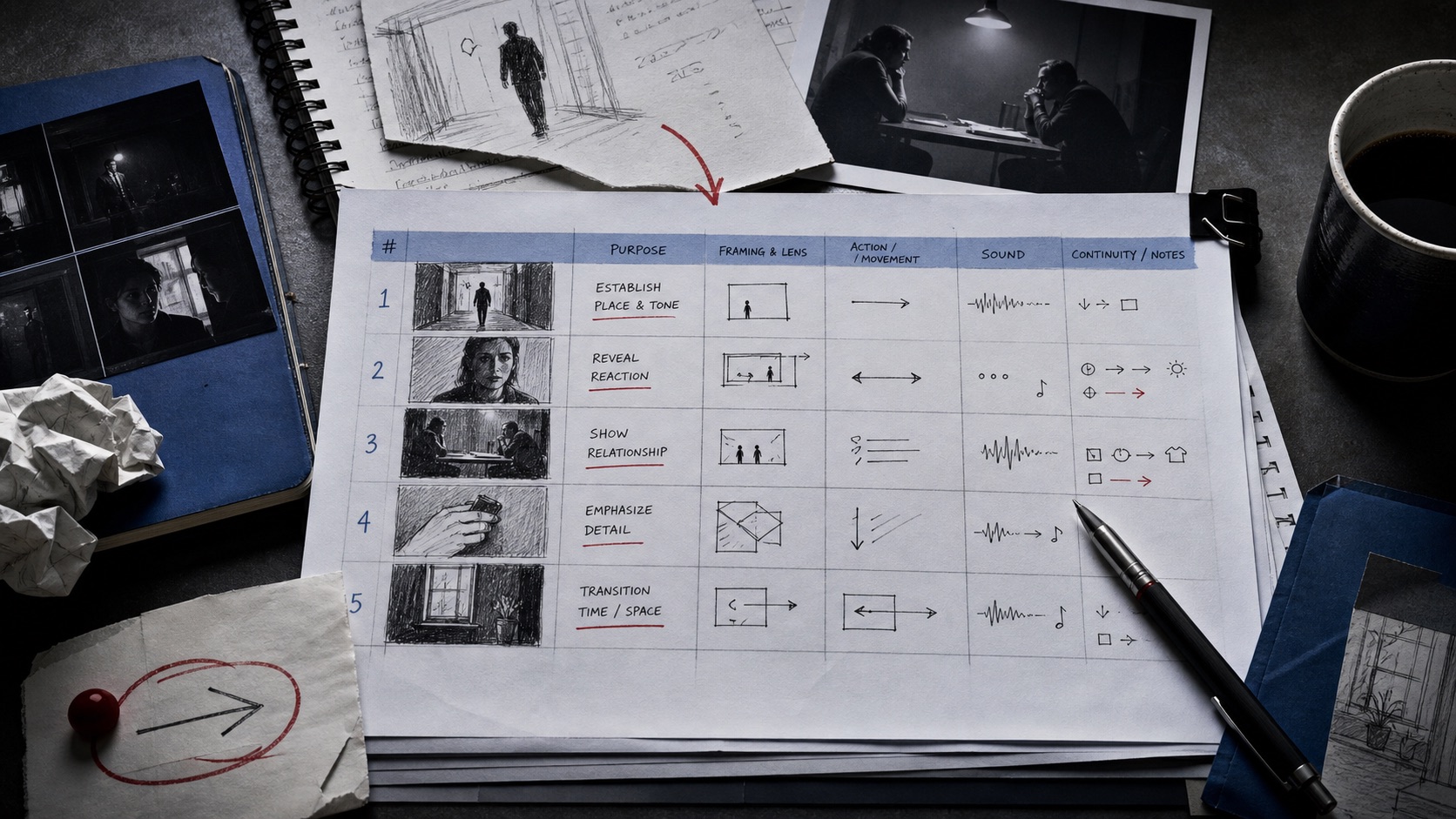
Key takeaways核心要点
- Include purpose, framing, action, sound, and continuity information for each planned shot.
- Separate must-have coverage from useful options and experiments.
- Keep the shot list linked to the scene objective and current script version.
A shot list is a bridge between a written intention and the material an editor will later need. It is not a promise that every circumstance will remain fixed, nor a substitute for looking at the location, performers, time, and available light. Its practical value is that it gives a team a shared account of what must be captured and why.
The list should be detailed enough to prevent accidental gaps, but not so rigid that it converts creative work into a transcription exercise. A useful entry makes the next action understandable to people with different responsibilities.
Start with the scene’s job
Before listing camera positions, write a sentence about the scene’s change. Does someone learn information, make a choice, hide a response, or lose control of a plan? That purpose helps distinguish essential coverage from attractive but optional images. Without it, a list can grow long while still failing to support the edit.
For each shot, include a stable identifier, scene reference, framing or composition, intended action, and a short note about narrative purpose. Add important sound, prop, screen-direction, or continuity needs where they affect the usable result. “Close reaction after message, preserve eyeline left” is more valuable than “CU.”
In a fictional unpublished scene set at a kitchen table, the must-have list might include an establishing relationship beat, the hand that hides a phone, the listener’s delayed reaction, and an insert of the message. The list does not dictate every lens or movement. It identifies the coverage needed to make the decision readable in the edit.
Separate necessities from possibilities
Mark shots as required, preferred, or exploratory. Required coverage protects the story and continuity. Preferred shots improve options if time allows. Exploratory shots invite a visual idea that may not survive the final cut. This ordering helps a crew make sensible choices when the day changes.
Note dependencies. A two-person over-the-shoulder may depend on a continuity reset; an insert may require a prepared screen graphic; a movement may need extra setup time. These are production facts, not bureaucratic additions. Naming them avoids discovering them after another department has moved on.
Keep alternate approaches close to the relevant item. If a reaction can be played wide or isolated, note the reason for both and the condition under which one becomes unnecessary. That gives the director and editor a record of intended flexibility rather than a mysterious surplus of takes.
Treat the list as a living record
Use the current script version as the source and update the list when the scene objective changes. A shot list that follows an obsolete page can create coverage for a beat that no longer exists. Record meaningful on-set deviations so post-production can understand what material was intentionally omitted or newly found.
At wrap, compare captured material to required items rather than trusting memory. Mark complete, partial, unusable, or not obtained, with a reason. That status can guide a pickup decision before the edit begins. It also prevents a missing shot from becoming an unexplained mystery in the timeline.
The list succeeds when it makes essential coverage visible and leaves room for judgment. Its purpose is not to eliminate surprise. It is to ensure that production choices remain connected to the story work they are meant to serve.