Production Workflow制作流程 · Explainer解读
Keeping Creative and Technical Notes Separate
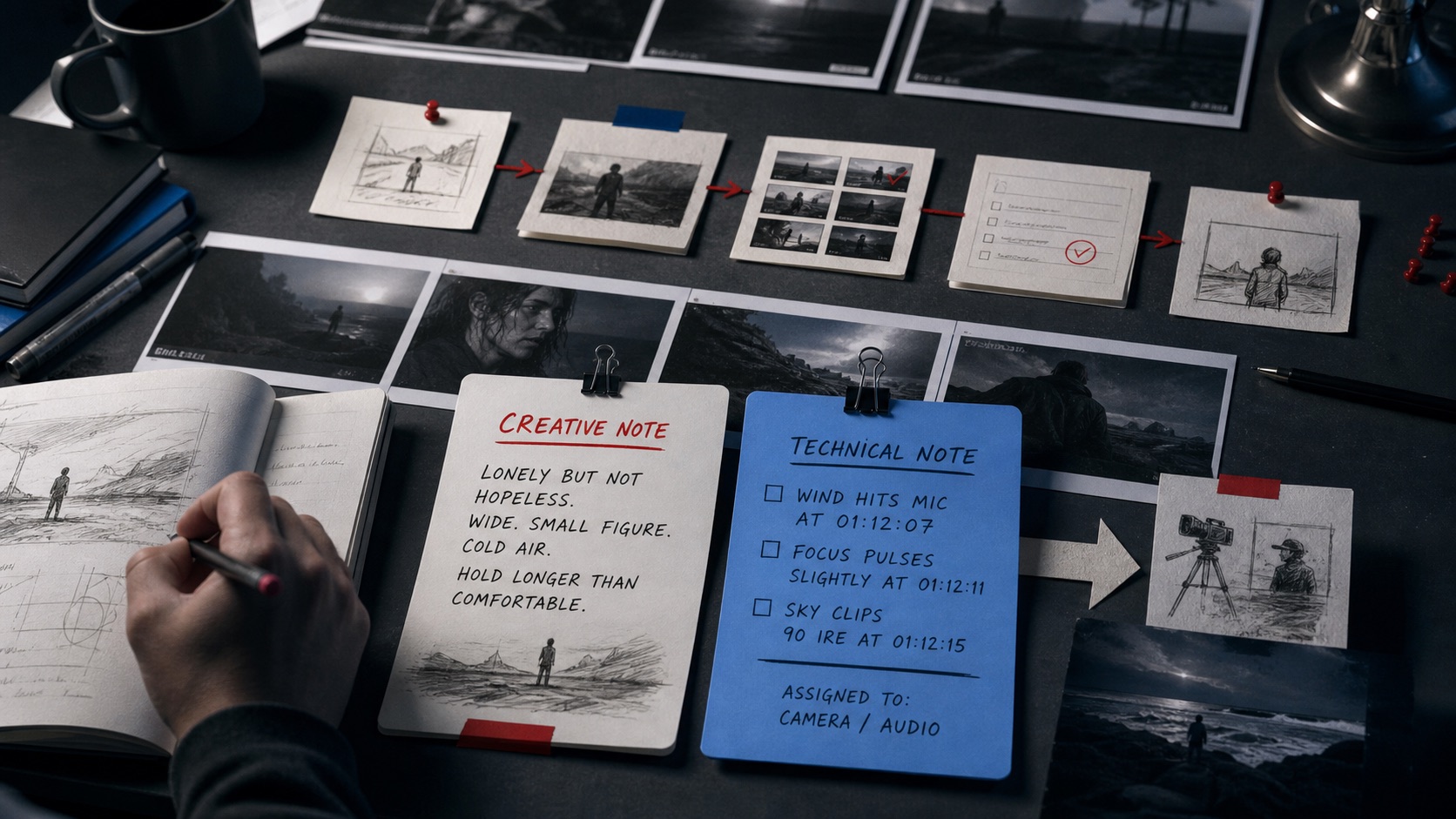
Separate note streams help a team preserve artistic discussion while giving technical defects a clear owner and verification path.
Key takeaways核心要点
- Creative notes discuss intended effect; technical notes identify a measurable condition.
- Use separate owners and closure tests when the response paths differ.
- Link both streams to one version so they do not drift apart.
A review can become unworkable when a discussion about character emphasis sits beside a report that an export has no audio. Both comments may be valid, but they have different owners, deadlines, and ways of being resolved. Treating them as one flat list makes the creative issue sound like a defect and the defect sound like a matter of taste.
Keeping notes separate does not divide the team into isolated silos. It creates clearer routes for responding, while preserving a shared view of the version under discussion. The important connection is the asset and its state, not an undifferentiated list of comments.
Name the kind of response required
Creative notes describe an intended experience: a reveal may arrive too early, a pause may need more room, or a scene may not make a relationship clear. They should identify evidence and a desired effect, but they may allow several possible solutions. The responsible maker needs judgment, not only compliance.
Technical notes describe a condition that can be checked: a subtitle overlaps an interface element, a file has an incorrect ratio, a link is broken, or a required field is absent. They should include a location, expected state, actual state, and a retest condition. Their resolution is normally demonstrable.
In a hypothetical unpublished review, “the final reaction lands before we understand the question” belongs in the creative stream. “The caption at 00:42 is clipped on a narrow screen” belongs in the technical stream. Both can refer to the same cut, but they should not compete for the same response language.
Route ownership and priority differently
Creative work may require a conversation between editor, writer, and director. Technical work may belong to an editor, caption specialist, or producer. Give each note an owner, but also state whether it blocks delivery, informs the next creative pass, or can be deferred. This keeps an urgent technical defect from being buried beneath optional refinement.
Avoid making technical notes a way to avoid creative disagreement. If someone says a scene is “technically unclear,” ask whether they mean a broken constraint or an uncertain audience effect. The distinction matters because the remedies are different. One can be tested against a specification; the other needs interpretation and a decision.
Use two views of the same review record if necessary: a creative agenda for discussion and a technical checklist for repair. Keep their version identifier and status links together. A worker should be able to see that a technical correction occurred without assuming that the creative approval also changed.
Rejoin the streams at the release gate
Before a release candidate moves forward, confirm both streams have reached their appropriate state. Creative questions may be approved, consciously deferred, or documented as a chosen trade-off. Technical blockers should be passed or explicitly waived by an authorized decision. Neither should disappear simply because the other is complete.
When a technical fix alters an editorial moment, send the change back through the right creative check. For example, shortening a caption to avoid clipping may change emphasis. This is where separation is helpful: it reveals the cross-over rather than hiding it inside a long comment thread.
Clear categories make notes kinder as well as more efficient. People can see whether they are being asked to repair a condition, make a proposal, or decide a trade-off. The result is not less conversation; it is a conversation that can move work forward.